
 |
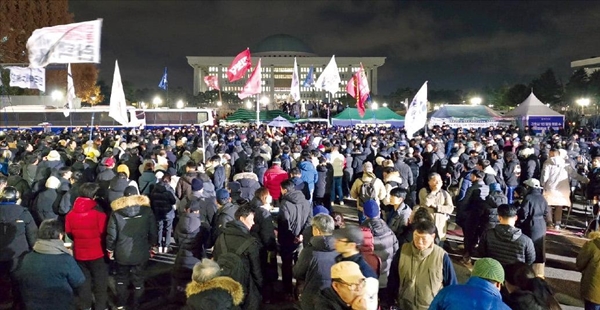
On the fateful night of December 3rd, 2024, the whole Korean peninsula and the world were shocked by President Yoon's sudden announcement of a nationwide martial law order. Millions watched anxiously as special forces landed on the grass fields of the National Assembly Building via helicopters and attempted to infiltrate the building that Koreans regard as a symbol of democracy. While the chaos ensued, with citizens blocking the soldiers' entry and buying time for Congress to halt the order, the Korean economy was going downhill. Local and international investors were watching helplessly as this political crisis could spell disaster for their investments, and it did.
The repercussions of this madness still ripple through the local economy, with Korea's currency, \, significantly depreciating against the U.S. dollar. Its worth dropped to a whopping 1450 won per dollar, with this phenomenon only precedent during the IMF and 2008 Financial Crisis. Companies face a significant increase in the cost of manufacturing goods as the cost of imports increases due to a decrease in currency worth.
 |
This will likely force companies to pass this responsibility to the market's consumers by marking up their products' prices, straining consumers' spending. This may further lead to a reduction in customer spending, one of the key primary factors that led to the 1997 IMF crisis. KOSPI, the Korean benchmark stock index, also fell around 0.9%, and Korean multinational companies like Samsung and LG faced a sharp fall in their stock prices. The martial law has proven to international investors that Korea's market is volatile and highly susceptible to political interference, thus driving away investments and tainting the image of the Korean economy.
The government and the Bank of Korea are trying to help the economy recover by introducing economic stimulus packages and intervening in the foreign exchange market to stabilize it. However, this has increased government spending and strained foreign reserves, which may increase debt accumulation. Regardless, the economy is showing signs of recovering, with stocks like Samsung climbing steadily at the time of writing. Can and will the Korean economy overcome this setback and prevail? Only time and statistics will tell.
이승빈 강남포스트 학생기자 webmaster@ignnews.kr
<저작권자 © 강남포스트, 무단 전재 및 재배포 금지>
 ‘제3회 역삼1동 어울림 한마당 축제’


