
 |
In my last article, I shed light on the concerning state of waste management at our school. reviously, our dormitories had only one general trash bin per building, which meant plastics, aluminum cans, glass bottles, and even food waste were all carelessly mixed together. Every morning, as the collection truck arrived, the reality became clear: effective recycling was impossible because all types of waste were indistinguishably merged.
This situation highlighted significant gaps in student awareness and the lack of proper waste separation facilities. Naturally, having a single trash bin meant students threw everything into it without consideration. Adolescents are at a crucial stage of forming lifelong habits; without proper facilities or guidance, the idea of recycling hardly crossed anyone's mind, even including myself. Unfortunately, once these behaviors become ingrained, they tend to persist into adulthood, leading to long-term environmental harm.
Recognizing this critical issue, I proposed and implemented a simple and effective measure to promote recycling and raise awareness at our school.
First, I convinced the school to install just one additional recycling bin on my floor, strategically placed right next to the original trash bin, so that students could easily notice it and and be encouraged to recycle. Simply adding one more bin significantly increased accessibility and began to influence students’ recycling habits. With convenient access, students naturally began to view recycling as an essential daily activity. I witnessed how making recycling straightforward and accessible encouraged students to incorporate this practice into their routines and carry these sustainable habits into their adult lives.
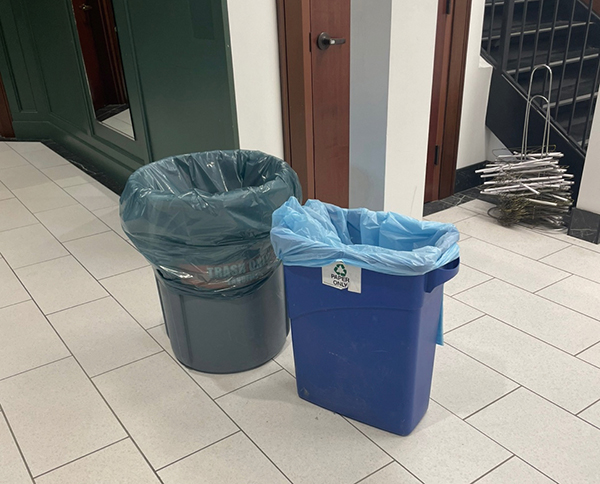 |
| Installation of the additional trash bin on my dormitory floor |
Another effective measure I took was placing a visual poster beside each trash and recycling bin. These visual instructions made a considerable difference in guiding students on how to correctly sort waste. By clearly listing recyclable items such as aluminum cans, plastics, paper, and glass bottles, the poster reinforced both the importance and simplicity of recycling. Furthermore, these visual cues delivered a direct, impactful message that recycling isn't just beneficial, but it's imperative.
Collaboration with the school's Eco-Club (Green Club) played an integral role in driving these changes. Club members enthusiastically participated by designing posters and organizing awareness campaigns. To amplify their impact, the club visited a local waste management facility, giving students a firsthand look at the negative outcomes of improper recycling practices. These tangible experiences vividly illustrated the consequences of poor waste management and motivated more students to actively participate in recycling efforts.
The positive effects of these combined initiatives became evident within weeks. Although a few students are still adjusting and occasionally revert to old habits, the improvements are remarkable. Many students now conscientiously separate printed or unwanted paper into designated recycling bins, while empty glass bottles and aluminum cans increasingly find their rightful places. Recycling rates have noticeably improved, reflecting enhanced student involvement and better waste sorting practices.
For my next article, I will examine the campaign's impact and gather students' feedback to bring more changes to my campus, and in the near future, my community.
박주혁 강남포스트 학생기자 webmaster@ignnews.kr
<저작권자 © 강남포스트, 무단 전재 및 재배포 금지>
 ‘제3회 역삼1동 어울림 한마당 축제’


