
 |
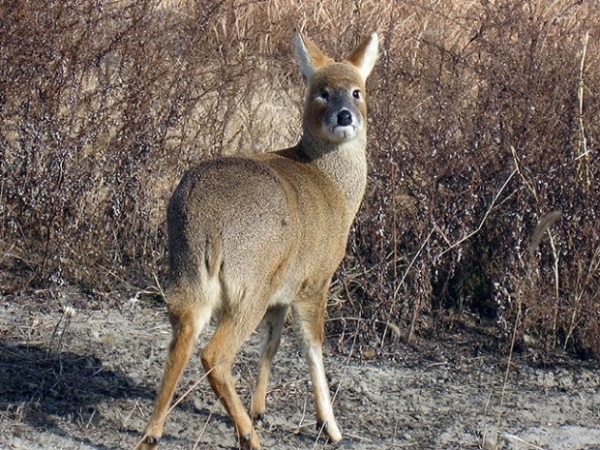
It is noteworthy that the water deer (Hydropotes inermis), commonly seen in mountains and along roadsides in South Korea, is actually a rare species on a global scale. The International Union for Conservation of Nature (IUCN) classifies the water deer as a Vulnerable species.
According to the National Institute of Ecology, the population of water deer in South Korea is estimated at around 700,000, accounting for approximately 90% of the global population. Although they are also found in parts of China and Russia, their numbers are rapidly declining due to poaching and habitat destruction. In contrast, their population in South Korea has surged due to the absence of natural predators and the abundance of food sources.
 |
However, this population boom has created new challenges. Water deer have become a major cause of crop damage and traffic accidents. According to a 2018 study by Choi Tae-young et al., approximately 30,000 to 60,000 water deer are killed in roadkill incidents annually, making up over 80% of all wildlife-vehicle collisions.
Park Hee-bok et al. (2018) suggested that, considering the jumping ability of water deer, fences designed to prevent roadkill should be at least 1.2 meters high. Nonetheless, many ecological corridors currently in place do not adequately accommodate the behavioral traits of water deer. In response, local governments have designated water deer as nuisance wildlife and are carrying out capture programs. Between 100,000 and 180,000 individuals are captured annually, highlighting the dilemma between maintaining ecological balance and protecting human life and property.
Dr. Kim Baek-jun, an ecologist, noted in the National Institute of Ecology’s ecological series that “although water deer are a globally protected species, they are often overlooked in Korea because of their abundance.” Water deer serve as mid-level consumers in the ecosystem and have a significant influence on vegetation structure.
Water deer give birth once a year without a distinct breeding season, usually bearing one or two offspring per litter. In areas with high population density, the boundaries between forests and farmland become blurred, intensifying habitat degradation and human-wildlife conflicts.
Experts stress that water deer should not be seen merely as targets for removal, but rather as subjects for ecological approaches and sustainable management strategies. Coexistence with water deer is linked to ecosystem restoration and requires more than just population control.
정진한 강남포스트 학생기자 webmaster@ignnews.kr
<저작권자 © 강남포스트, 무단 전재 및 재배포 금지>
 ‘제3회 역삼1동 어울림 한마당 축제’


