
 |
A bus strike took place in Seoul on January 13–14, 2026. The strike caused significant inconvenience to citizens and disrupted traffic throughout the city. The main reason for the Seoul city bus strike was a dispute over wage increases.
The union claimed that despite a recent court ruling that wages should be raised by 12.85 percent, management failed to fully implement the increase. In addition, the union opposed the company’s proposal for a 10 percent wage increase, arguing that although it appeared to be a raise, it would not actually lead to a meaningful increase in real wages.
Moreover, with consumer prices rising by approximately 2.3 percent from a year earlier, the cost of living for city bus drivers has increased, further intensifying the union’s dissatisfaction.
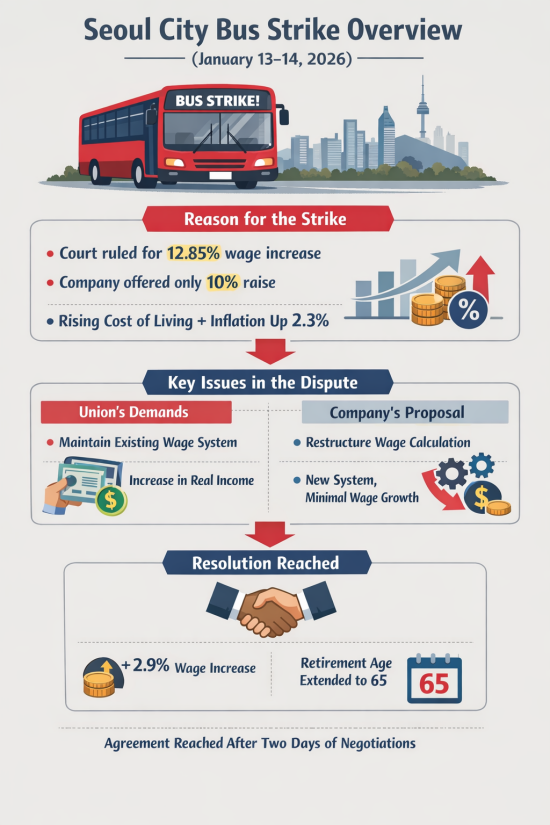 |
Another key issue in the strike was the method of calculating wages. The union insisted on maintaining the existing wage system, which is based on regular wages paid consistently to all workers. Under this system, an increase in the basic hourly wage leads to a rise in actual monthly income.
In contrast, the company argued that the wage calculation system needed to be restructured. The union countered that changes to the regular-wage-based system could disadvantage workers in the long term or result in only minimal wage growth.
Negotiations between the union and management continued into the night of January 14, the second day of the strike. Eventually, both sides agreed to a 2.9 percent wage increase and an extension of the retirement age to 65.
In an era of rising prices, determining a wage structure that protects workers’ livelihoods while remaining sustainable for society is an issue that must be carefully considered in future negotiations.
원가영 강남포스트 학생기자 webmaster@ignnews.kr
<저작권자 © 강남포스트, 무단 전재 및 재배포 금지>
 ‘제3회 역삼1동 어울림 한마당 축제’


