
 |
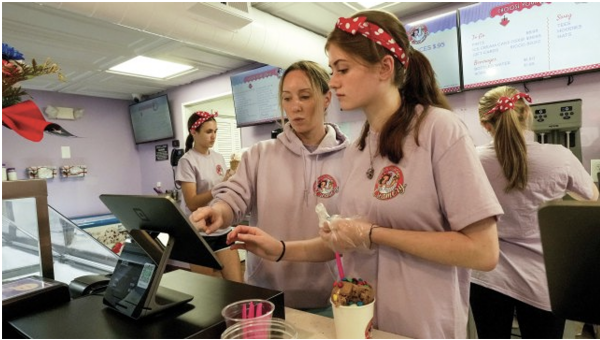
In the United States, part-time jobs are common among many teenagers, whether after school or on weekends, in places ranging from fast-food restaurants to grocery stores and recreational centers. However, why is this less common among teenagers residing in Korea?
A 2024 report by Korea’s Ministry of Gender Equality and Family found that 6.2 percent of students had recent part-time work experience. In contrast, 32.2 percent of Americans ages 16 to 19 were employed in 2024, according to the U.S. Bureau of Labor Statistics.
Although the two sources used different age groups and definitions in their research, this large gap still points to a striking difference in how common part-time work is in these two countries.
 |
A clear factor behind this phenomenon is the law. In South Korea, minors under the age of 15 are typically not allowed to work, with limited exceptions that require an employment permit. On the other hand, U.S. federal law allows teenagers to work non-agricultural jobs as young as 14.
Besides the fact that teenagers can earn money from part-time jobs, they learn many crucial life skills through their work experience. These include punctuality, the ability to communicate with customers, and an understanding of the value of money.
According to a 2025 government survey, 73 percent of middle school students and 63 percent of high school students participated in private education, spending an average of 7.2 and 6.6 hours per week, respectively. This can leave students with less time to take on part-time jobs.
In the end, it is undeniable that labor laws and students’ educational commitments will continue to play a significant role in teenage employment in South Korea.
박서준 강남포스트 학생기자 webmaster@ignnews.kr
<저작권자 © 강남포스트, 무단 전재 및 재배포 금지>
 ‘제3회 역삼1동 어울림 한마당 축제’


