
 |
Plastic waste has been a growing issue that people face everywhere across the world. Even though it is undeniable that plastic provides various societal benefits from its light weight and mechanical strength, it is evident that it mostly leads to negative environmental and social impacts. This includes carbon emissions, dangers to wildlife, and contributions to global warming. Bioplastics and biodegradable materials derived from renewable sources are being produced and commercialized through a variety of environmentally friendly products to address the issue of plastic waste and pollution.
In research from McKenna (2015), leading companies such as Coca-Cola, Nestle, Nike, and Ford are exhibiting their interest in the production and usage of bioplastic materials. For instance, Coca-Cola produced 35 billion PlantBottles - a bottle made from PET that contains up to 30% of biobased material. Furthermore, most companies that have certified bioplastic products on the cover have seen their sales increase by more than 20% in South Korea which shows a great deal of public interest in environmentally friendly products.
Despite the positives, it is also essential to have a look at the negative aspects of bioplastic. Bioplastic is relatively expensive because of the complex process used to convert food sources into building blocks for PLA. “PLA can be 20 to 50 percent more costly than other materials” states Renee Cho, an author at State of the Planet. Moreover, it is expected that as it becomes more commercialized, huge markdowns in prices will take place.
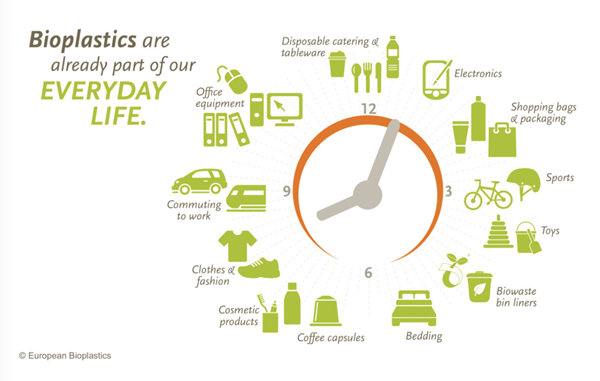 |
| Reference: https://www.european-bioplastics.org/ |
Another disadvantage to focus on is that bioplastics are designed to be composted, not recycled - many different types of materials must be separated before they have any chance of being recycled. However, this also takes a bright view of perspectives because biobased, biodegradable plastics are making developments to produce new innovative materials to reduce pollution. Bioplastic is present in various contemporary market segments of environmentally friendly products, and it is definite that it has more advantages than disadvantages in its value.
플라스(+)틱 대신 마이너스(-)틱
플라스틱의 이 가볍고 기계적인 힘으로부터 다양한 사회적 이익을 제공한다는 것은 부인할 수 없지만, 대부분의 플라스틱이 환경적, 사회적 부정적인 영향을 초래한다는 것은 명백하다. 이것은 탄소 배출, 야생 동물 위협, 지구 온난화에 대한 기여 등을 포함한다. 플라스틱 폐기물과 오염 문제를 줄이기 위해 재생 가능한 원료에서 나오는 바이오 플라스틱이나 생분해성 물질을 다양한 친환경 제품을 통해 개발, 상용화한다.
맥케나(2015년)의 연구에 따르면 코카콜라, 네슬레, 나이키, 포드 등 유수의 기업들이 바이오 플라스틱 재료의 생산과 사용에 관심을 보이고 있다. 코카콜라 회사는 350억 개의 식물병을 생산했는데, 이것은 바이오 기반 물질의 최대 30%를 함유한 PET로 만든 음료수 병이다. 나아가 표지에 바이오 플라스틱 제품을 인증한 기업 대다수가 국내에서 20% 이상 매출이 증가해 친환경 제품에 대한 국민적 관심이 큰 것으로 나타났다.
긍정적인 측면에도 불구하고, 바이오 플라스틱의 부정적인 측면을 살펴보는 것도 필수적이다. 바이오플라스틱은 식량원을 PLA의 빌딩 블록으로 전환하는데 사용되는 복잡한 과정 때문에 상대적으로 비용이 많이 든다. State of the Planet의 저자인 Renee Cho는 "PLA는 다른 재료보다 20-50% 더 비쌀 수 있다"고 말한다. 더구나 상용화에 따라 가격 하락이 크게 일어날 것으로 예상된다.
집중해야 할 또 다른 단점은 바이오 플라스틱이 재활용이 아니라 퇴비로 설계되었다는 것이다. 많은 다양한 종류의 물질들이 재활용될 기회를 갖기 전에 분리되어야 하지만, 이것은 또한 바이오 기반의 생분해성 플라스틱이 재활용을 끝내기 위해 새로운 혁신적인 물질을 생산하기 위한 개발을 하고 있기 때문에 밝은 전망을 가지고 있다. 바이오플라스틱은 친환경 제품의 다양한 현대 시장 부문에서 존재하며, 그 가치에서 단점보다 장점이 더 많은 것이 분명하다.
박지후 강남포스트 학생기자 webmaster@ignnews.kr
<저작권자 © 강남포스트, 무단 전재 및 재배포 금지>
 ‘제3회 역삼1동 어울림 한마당 축제’


