
 |
The desire for a sense of belonging and the inclination to form and belong to a group are natural human instincts. In that sense, humans have always created voices in order to be heard and valued. For example, in the nineteenth century, women and men who pushed for gender equality joined forces to get suffrage for women, and the voices are still heard today to guarantee that their rights are protected. This movement evolved into feminism, the belief in full social, economic, and political equality for women, uniting individuals in a common aim of tearing down the glass ceilings, or societal constraints, that still exist in society. Since the feminism movement has been going on for more than a century, a significant number of people have become aware of it and have begun to accept feminist voices, though there is a disparity in the rate of this acceptance, which varies due to the diversity of cultures and atmospheres in each country.
 |
| http://www.koreaherald.com/view.php?ud=20210620000168 |
Another group of people is always raising their voices to protect their rights, but they are not given the same level of recognition as feminists. The LGBTQ+ community is an acronym that stands for "lesbian, gay, bisexual, transgender, queer/questioning, and more." In comparison to the East (countries in Asia), people in the West (countries such as the United States and European countries) are more aware of the community. Several Western states and nations have implemented anti-discrimination laws aimed at the LGBTQ+ community, and many people who do not identify as LGBTQ have joined the group as supporters.
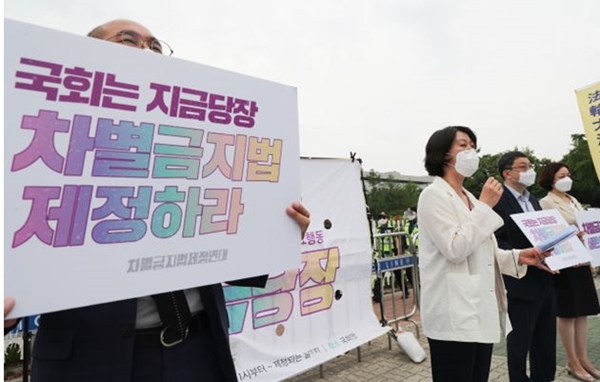
However, the situation in Korea looks quite different. Although Korea has been modernizing with a lot of introduction of western ideas and supplies since the twentieth century, it still has certain deep-rooted traditions or beliefs of Confucianism, and some combined with Christianity, which was introduced to Korea in the nineteenth century. These two religions can be considered as having very conservative perspectives, especially on gender, since it strictly divides roles and expectations for genders and identifies only two genders (male and female) as official sexual identity. Due to these backgrounds of Korea, awareness regarding the LGBTQ+ community falls behind than it does in other countries. In an effort of alleviating the struggle for the LGBTQ+ community, the government of Korea has been making various attempts to pass the anti-discrimination law. However, the majority of citizens in Korea are strictly against it, making petitions to prohibit the enactment of the law.
Accepting what goes against one's traditional views or enduring social marginalization is a problem for both sides. The world is constantly evolving and will continue to do so. We must all "respect" one another, and it is critical, especially in this changing world, to reach an agreement on the scope of that respect.
이주아 강남포스트 학생기자 webmaster@ignnews.kr
<저작권자 © 강남포스트, 무단 전재 및 재배포 금지>
 ‘제3회 역삼1동 어울림 한마당 축제’


