
 |
The human population is expected to exceed 9 billion by 2050 and approximately 11 billion by 2100. Resources such as space and food are expected to become scarce as the population grows. Is it feasible that farming will be the future of jobs?
The Earth can currently sustainably generate enough food for 10 billion people. However, due to inequity in food distribution and the quantity of food wasted, there is now insufficient food to feed everyone. One option is to simply create more food. It is tough to develop a method for sustainably generating food. Many nations just do not have the area for large farms and must thus import most of their food. As a result, strategies for more space-efficient farming must be devised.
Instead of the usual horizontal farms, we could build them vertically. These farms often cultivate crops in controlled conditions, which improves agricultural efficiency. To maximize plant development, the amount of light and soil utilized may all be regulated. All of this may be cultivated in shipping containers or urban structures, allowing towns to grow their food without wasting energy on importing food, which also pollutes the air.
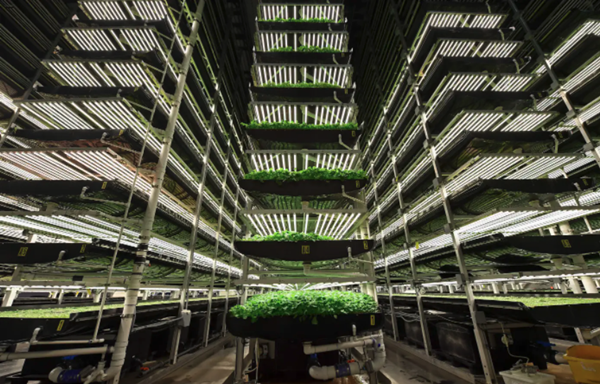 |
| Vertical Farm image source: https://techcrunch.com/2021/11/04/a-chat-with-the-author-of-the-vertical-farm/ANGELA WEISS/AFP / Getty Images |
Why hasn't this been done already? It has, although not on a huge scale. Countries such as the United States, Japan, China, South Korea, and Singapore have already begun to create vertical farms, with the United States already having thousands. Some crops may be grown without soil using techniques such as aeroponics and hydroponics, which use a liquid solution providing nutrients to grow the crops. Vertical farming will likely become much more frequent as technology like this improve and can help alleviate the problem of overpopulation and limited resources.
Will this alleviate the world's impending food shortage? Most likely not. Inequality and resource waste are at the basis of the problem. People in the world's richest 15% just have too much food, and much of it goes to waste.
Will this alleviate the world's impending food shortage? Most likely not. Inequality and resource waste are at the basis of the problem. People in the world's richest 15% just have too much food, and much of it goes to waste. Furthermore, much food is wasted or utilized as livestock feed throughout the food production process. This food is sufficient to solve the world's food crisis, feeding over 2 billion people. While vertical farming will not completely fix the problem, more sustainable and inventive ideas like these will hopefully take the globe to a more equitable and better future.
박세준 강남포스트 학생기자 webmaster@ignnews.kr
<저작권자 © 강남포스트, 무단 전재 및 재배포 금지>
 ‘제3회 역삼1동 어울림 한마당 축제’


